3 Trading Comeback Stories: What Changed After the Losses
The useful part of a trading comeback story is what changed between the setback and the next decision. Three traders’ own accounts offer different starting points: learning more techniques, making actions consistent, and protecting a process after confidence returns. Their stories can give you something specific to investigate when another motivational slogan does not help.
These are attributed public accounts, not interviews we conducted or independently audited performance records. The authors also publish or sell trading education. None of the sources says they used Price Action Trading Simulator; the practice exercise below is our own.
Adam Grimes: knowing more did not immediately stop the losses
Grimes describes an early version of himself with an ambitious plan and little understanding of risk. When that did not work, he studied intensely: books, chart patterns, indicators and notebooks of calculations. He returned to the market with much more knowledge and, in his account, continued losing. Read his original recollection.
That is a recognisable moment for a beginner: you can explain more things, yet still cannot show what you do differently. In a separate personal essay, Grimes describes a change in how he regarded individual losses and the importance he placed on risk and discipline. His account of that change describes a shift in perspective, not a timetable someone else can follow.
Our takeaway is a question: what has the latest thing you learned changed in an observable decision? If you cannot answer yet, more vocabulary may be the wrong next exercise. The learning-confusion guide helps isolate a task you can actually practise.
Rayner Teo: changing methods made the learning harder to interpret
In his podcast transcript, Teo recounts several losing years before the improvement he reports. He describes moving between approaches and emphasises consistent actions, testing whether an approach has an edge, and letting go of the idea that professionals possess one secret method. Read the original transcript.
The interesting question is what a review can tell you when the rules keep changing. Imagine a notebook containing three different entry rules, but only one combined result. You cannot cleanly tell which rule produced which decisions. That is our example of the problem, not a reconstruction of Teo’s trades.
A useful practice output is a dated rule version and a note whenever you depart from it. Consistency makes the record easier to inspect; it does not make an unprofitable rule profitable. Use the journal and review guide to separate rule compliance from outcome.
Humbled Trader: progress did not make later mistakes impossible
Shay’s account includes early losses and hopping between alert rooms, then the progress she attributes to changes including risk management and keeping employment income while learning. Her story also contains a later SNAP position to which she added exposure while moving away from her original plan. Read her full account.
That later setback makes the narrative more useful than a simple before-and-after victory. A turning point is not permanent immunity from another mistake. Our review question is: which boundary would still apply after a run of good outcomes? Write the boundary before the next exercise so you can check an action against it afterward. The discipline guide gives examples of making those rules observable.
What can you take from the stories?
| Account | A question worth investigating | Something you can record |
|---|---|---|
| Grimes | Has studying changed an actual decision? | One condition you can identify on an unseen chart |
| Teo | Are you comparing decisions made under the same rules? | Rule version, decision and any exception |
| Shay | Which boundary survives a good run? | The boundary written before the next decision |
These are our learning prompts, not a combined strategy endorsed by the authors. The selection also leaves out people who continued and did not recover. A few published journeys cannot tell you how often a comeback happens, how long yours might take, or whether continuing with real money is appropriate.
Try one separate, historical chart exercise
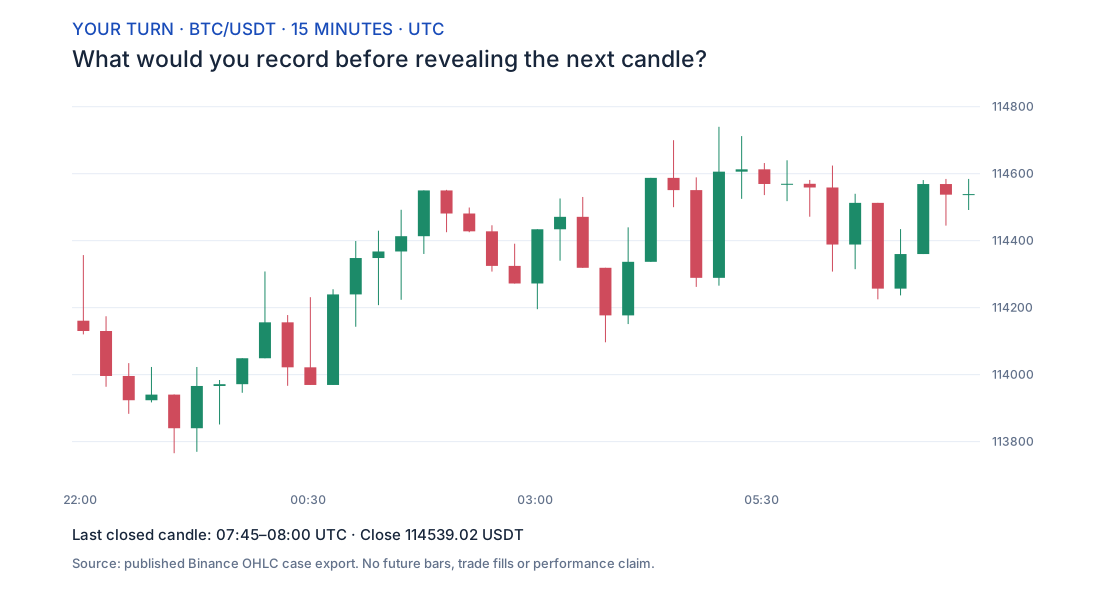
Here is a real chart paused at 08:00 UTC on 1 October 2025. It contains 40 fully closed 15-minute BTC/USDT candles from the site’s published Binance data. The final candle covers 07:45–08:00 UTC. No later candles are shown. This is an independent exercise, not a chart from any of the three people’s trades.
- Choose one question from the table. For example, whether you can keep the same decision rule when you are tempted to act early.
- Write the rule before looking ahead. Use a condition you can check, or write what information is still missing. Waiting or standing aside is a decision too.
- Record your decision and reason. Keep the first entry visible. If you change the rule, label the change instead of editing the earlier explanation.
- Review the process separately from the outcome. Ask whether the condition was satisfied and whether the decision followed the written rule. A favourable next candle cannot answer both questions for you.
An example row might read: Rule: wait for the specified candle to close. Decision: entered before that close. Review: the entry departed from the rule. Next exercise: record the closing time before choosing an action. This is an illustrative review row; the chart does not establish that the entry occurred or that the rule has an edge.
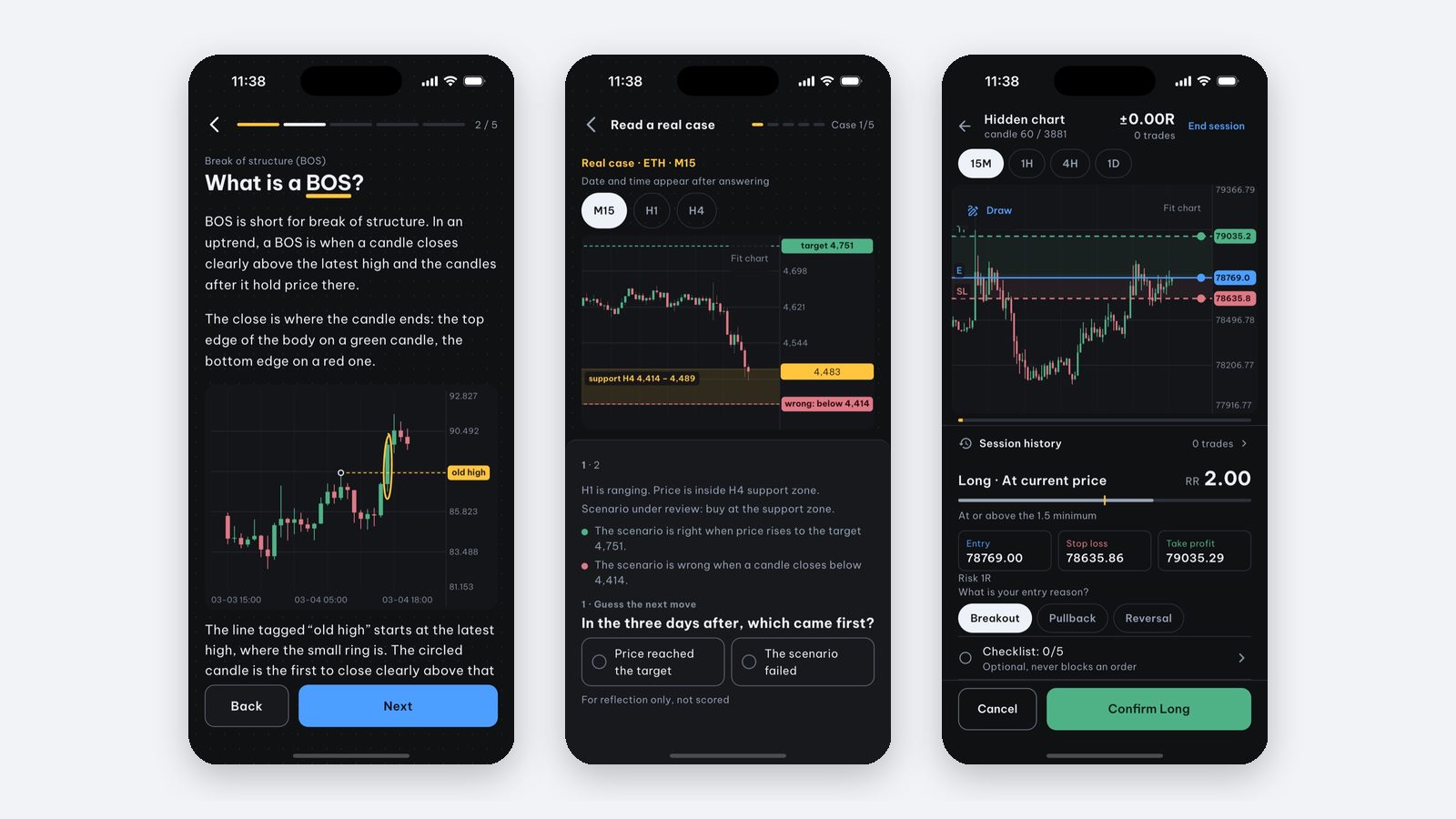
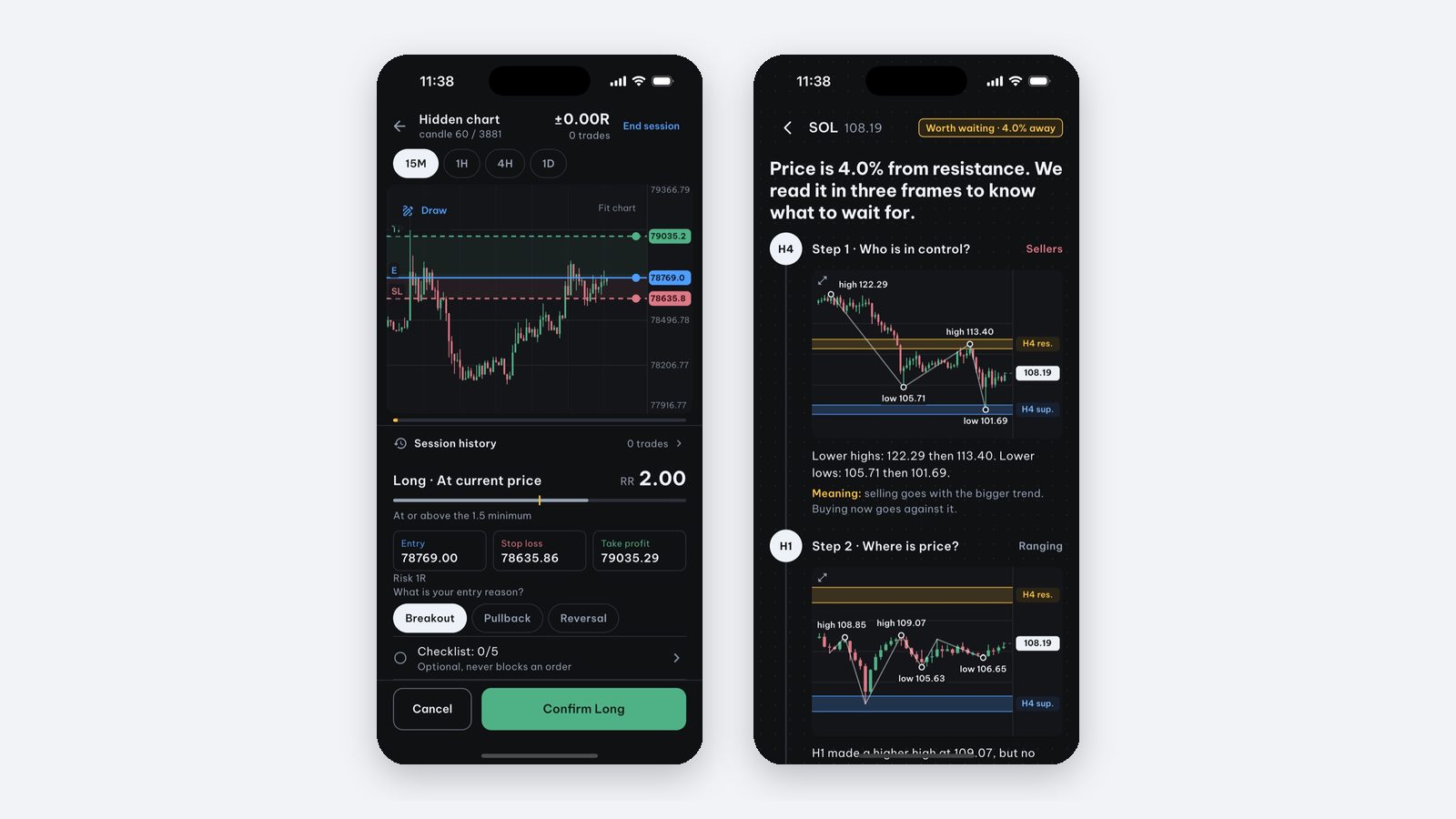
You can do the written exercise without an app. If you want to continue with candles revealed one by one, Price Action Trading Simulator offers historical practice on iPhone and iPad. The opening chart-reading check and one five-case session are free. Starting a manual backtest session requires Pro, and saved sessions let you review decisions. It uses no real money and has no broker connection. Our data and case methodology explains the chart sources and the limits of simulated outcomes.
The next useful milestone is a decision record you can inspect: what you intended, what you did and what you will test next. A comeback story can start that conversation. Your own evidence has to carry it forward.
Frequently asked questions
What can I learn from a trading comeback story?
Look for the behavior the person changed, the evidence they used and what remained difficult. A personal success account cannot establish your odds of becoming profitable.
Does a losing period mean I should keep trading until I succeed?
No. These selected accounts do not show what happens to everyone who continues. You can study and rehearse decisions without putting more money at risk; a story does not decide whether live trading suits your circumstances.
Should I copy the strategy used by a successful trader?
A named strategy is not enough to reproduce someone's circumstances or results. Extract a question you can investigate, write the rules and examine the evidence and assumptions instead of copying a trade.
Can I practise a lesson from these stories without real money?
Yes. Use a historical chart with its future hidden, write one rule and review whether your decision followed it. That practises the process; it does not validate a profitable strategy or reproduce the pressure of real financial loss.
Written by the app’s development team. See the data, selection rules and limits of these first-party examples. Sources & method →
Keep reading
-
How to Stay Calm and Disciplined When Trading
Turn trading discipline into observable checks: written rules, planned risk and a record of deviations. Practice supports review, not a promise of calm.
-
Trading journal: what to record and how to review mistakes
Record rules and planned risk before entry, then actual fills, costs and compliance. A journal separates execution mistakes from an untested strategy.
-
I study trading but still feel lost. What should I practise?
If more trading videos leave you confused, find the first task you cannot perform: reading candles, defining a rule, sizing risk or reviewing decisions.