Trading journal: what to record and how to review mistakes
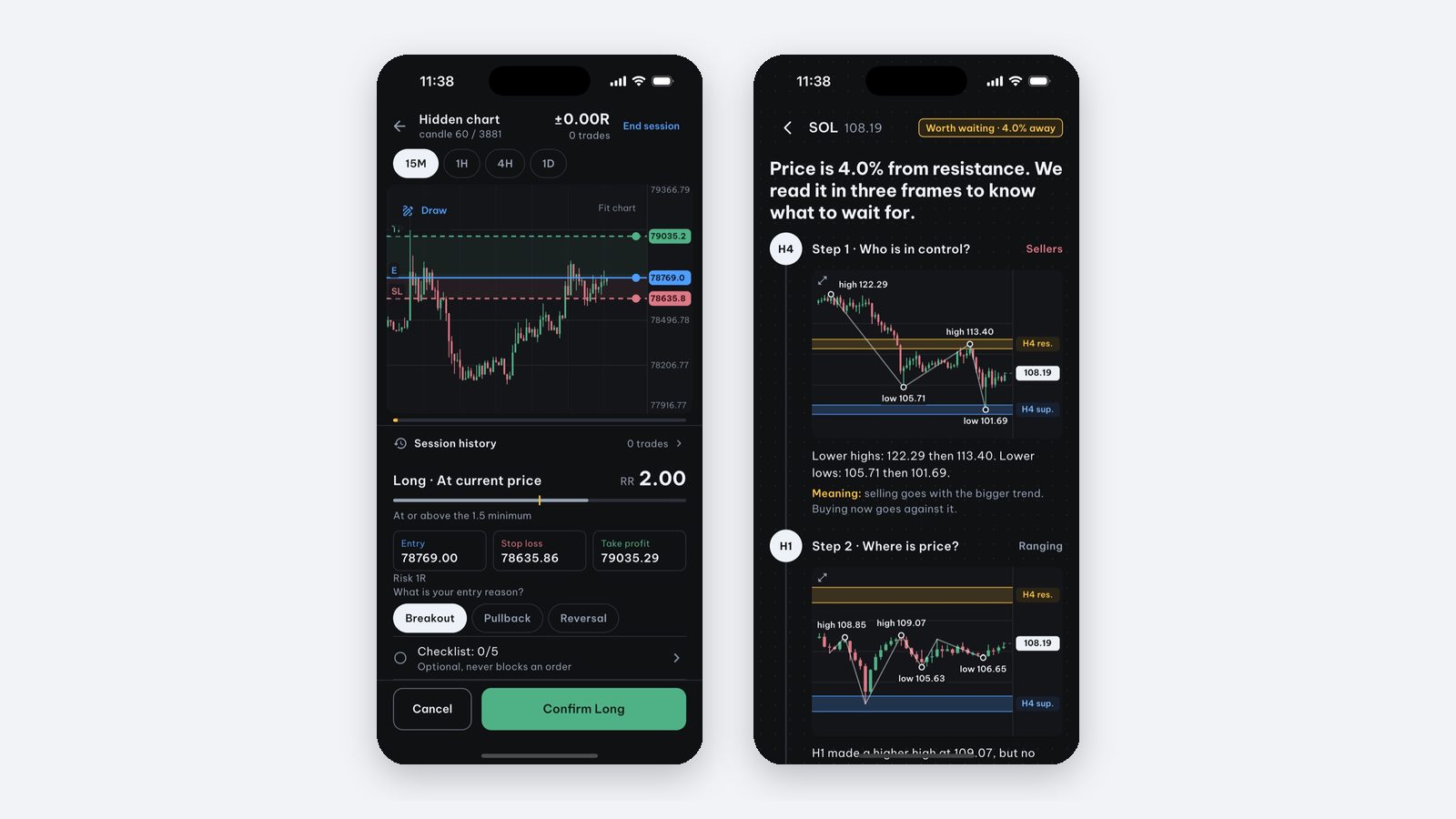
Write the plan before the decision and the execution after it. A useful trading journal separates three things: what your rule required, what you actually did, and the net result. Following a plan is evidence of compliance; it does not prove the plan makes money.
What do I record before a trade?
Use fields you cannot quietly change after seeing the outcome:
- Decision time and timezone, market and timeframe.
- Rule version, trigger and a screenshot with future candles hidden.
- Planned entry, stop trigger, target, size and cash risk, called 1R.
- Cost assumptions and no-trade conditions.
If you cannot explain the trigger in one checkable sentence, mark it ambiguous instead of filling in a reason later. The plan template helps define these fields.
What goes in the result column?
For a linear position, net R = (gross profit or loss − costs) ÷ initial planned cash risk. Use the initial risk even if you changed the stop; otherwise the comparison moves with your mistake.
Hypothetical example: initial risk 10 USD. Entry 100, stop 98, size 5 units. A fill at 98 loses 10 USD gross. If total costs are 1 USD, net R = (−10 − 1) ÷ 10 = −1.1R, not −1R. If a changed stop produces a fill at 96, gross loss is 20 USD and the journal still divides by the original 10 USD.
| Type | Reference or fill | Cost | Result | Process |
|---|---|---|---|---|
| Simulated fixed-stop example | Entry 100; exit 98; 5 units | 1 USD assumed | −1.1R net | Check against written rule |
| Stored SOL zone observation | References 165.6875 / 163.1725 / 176.5875 | Not modelled | No executed R available | No trader compliance recorded |
Why isn’t the real SOL case a −1R journal entry?
The November 10, 2025 SOL/USDT export records a zone and future candles, not an order. Its first later M15 low below 163.1725 occurred in the candle opening November 11 at 09:15 UTC. The first close below was 163.05 at 12:45 UTC. A fixed stop would be a different simulated rule from waiting for that close.
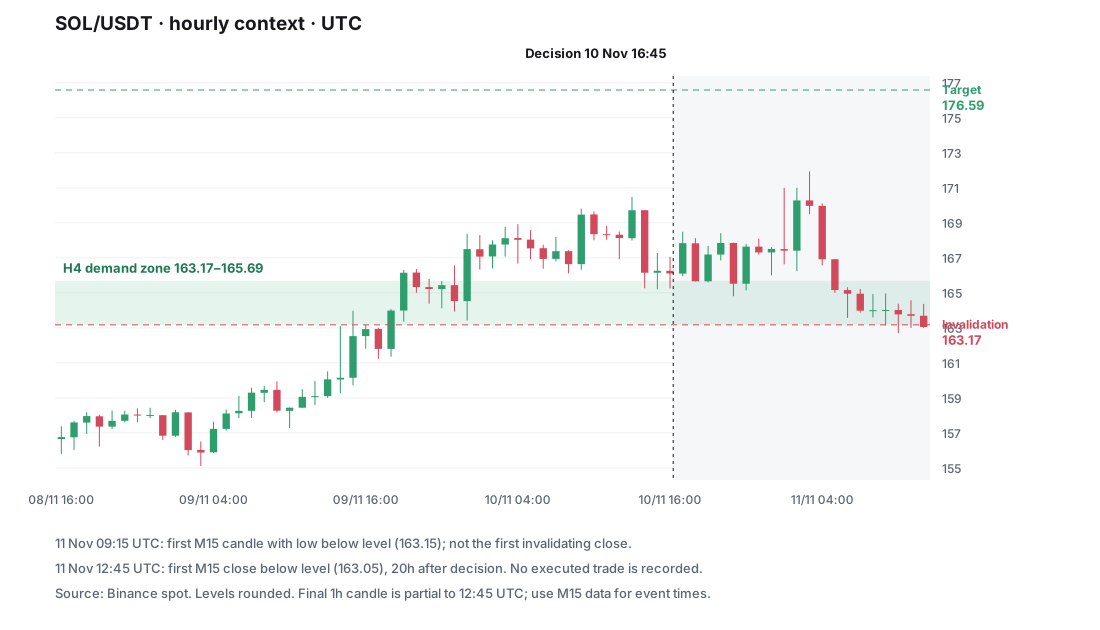
See the methodology and raw data. Do not label an unexecuted observation “followed plan: yes” or “mistake: none” without a plan and execution record.
How should I review the journal?
Choose a regular review point and ask:
- Is every eligible decision recorded, including skips and losses?
- How many followed the same version of the rule? For example 7 ÷ 10 = 70% in this exercise.
- Which deviations are observable: early entry, different size, stop moved, missing cost?
- What are net results for each group, and how small or selective is the sample?
- Which single ambiguity can I remove before the next exercise?
A result gap between compliant and noncompliant groups is descriptive; different market conditions may also explain it. Do not call the entire gap the cost of rule-breaking. Assess a strategy on untouched data as described in does price action work?.
Price Action Trading Simulator saves manual backtest sessions on iPhone and iPad. It has a configurable simulated fee in R, but no broker import or data export. Copy needed fields into your journal. Setup is free to browse; starting a session needs Pro, and the app does not trade real money.
Source and scope: this is educational material by the Price Action Trading Simulator development team. Price/account examples are hypothetical unless identified as a historical observation; exact fills and omitted costs are assumptions, not guarantees. Our case-data methodology explains the historical sources, selection and limits.
Frequently asked questions
What should I write in a trading journal?
Record the rule version, decision time and timezone, market, trigger, entry, exit, size, planned risk and costs. Afterward add actual or assumed fills, net R and whether each written rule was followed.
Does following my trading plan mean I made a good trade?
It establishes process compliance, not that the plan has an edge. Evaluate compliance and net strategy performance separately. One win or loss cannot settle either question.
How many trades should I review at once?
Choose a review schedule before collecting data. A short batch can find logging errors, but no universal count such as 20–30 validates a strategy or readiness for real money.
Can I journal simulator decisions?
Yes. Label them simulated, write the fill and cost assumptions and keep the rule version. Price Action Trading Simulator saves backtest sessions locally; it does not export data or import broker fills.
Written by the app’s development team. See the data, selection rules and limits of these first-party examples. Sources & method →
Keep reading
-
How do I write a trading plan? A fill-in template
A trading plan is one page of rules written before you trade: market, setup, entry, stop, target, risk per trade, daily loss limit and a review routine.
-
Why is my backtest profitable but live trading loses?
Audit the backtest-to-live gap: costs, fills, future leakage, rule changes and market exposure. Use a matched decision record before blaming psychology.
-
How to Stay Calm and Disciplined When Trading
Turn trading discipline into observable checks: written rules, planned risk and a record of deviations. Practice supports review, not a promise of calm.