How long should I practice before trading real money?
There is no number of weeks, wins or practice trades that proves you are ready to trade real money. Use practice to find what you still cannot explain or execute. A clear plan and consistent logging are useful process checks; they do not establish an edge or make financial risk suitable for you.
What should I check while practising?
Keep two questions separate: “Can I follow the rule?” and “Does the rule have evidence of a positive net result?”
| Check | Evidence you can record | What it does not establish |
|---|---|---|
| Rule clarity | Entry, exit, sizing and no-trade conditions written before the reveal | That the rule makes money |
| Process consistency | Count of decisions matching that version of the plan | That the plan is worth following |
| Risk arithmetic | Planned cash risk, stop distance and units | A guaranteed maximum loss |
| Testing quality | Unseen periods, all eligible trades, costs and assumptions | Future performance |
| Practical limits | Time available, order knowledge and ability to bear losses | A universal safe starting size |
For example, in a hypothetical practice exercise, 18 of 20 decisions match your rule: 18 ÷ 20 = 90% compliance. That describes this exercise. It says nothing about the rule’s win probability, its uncertainty or whether you should use real money. Review the two exceptions and write what you could actually check next time.
Why are 20–30 trades not a readiness threshold?
A short batch can reveal missing journal fields, inconsistent stops or hindsight. It can also omit conditions in which a rule fails. Closely spaced trades may share the same market exposure. Trying many rule versions and keeping the winner adds selection bias.
If you choose 20 practice trades as a first review, label it a logging exercise. For a strategy assessment, record every attempted version and test a frozen rule on untouched data with costs. Read what evidence a price action rule needs.
How do replay, demo and live trading differ?
- Historical replay: many decisions in less time; vulnerable to peeking, cherry-picking and optimistic fills.
- Demo on current prices: platform and schedule practice in real time; still simulated money and execution.
- Live trading: actual fills, costs and financial consequences. Neither replay nor demo reproduces all of these.
Moving from replay to demo can be another practice step. A good replay score is not a reason by itself to move to live trading. The backtest-to-live gap explains the differences to inspect.
What can I practise in the app?
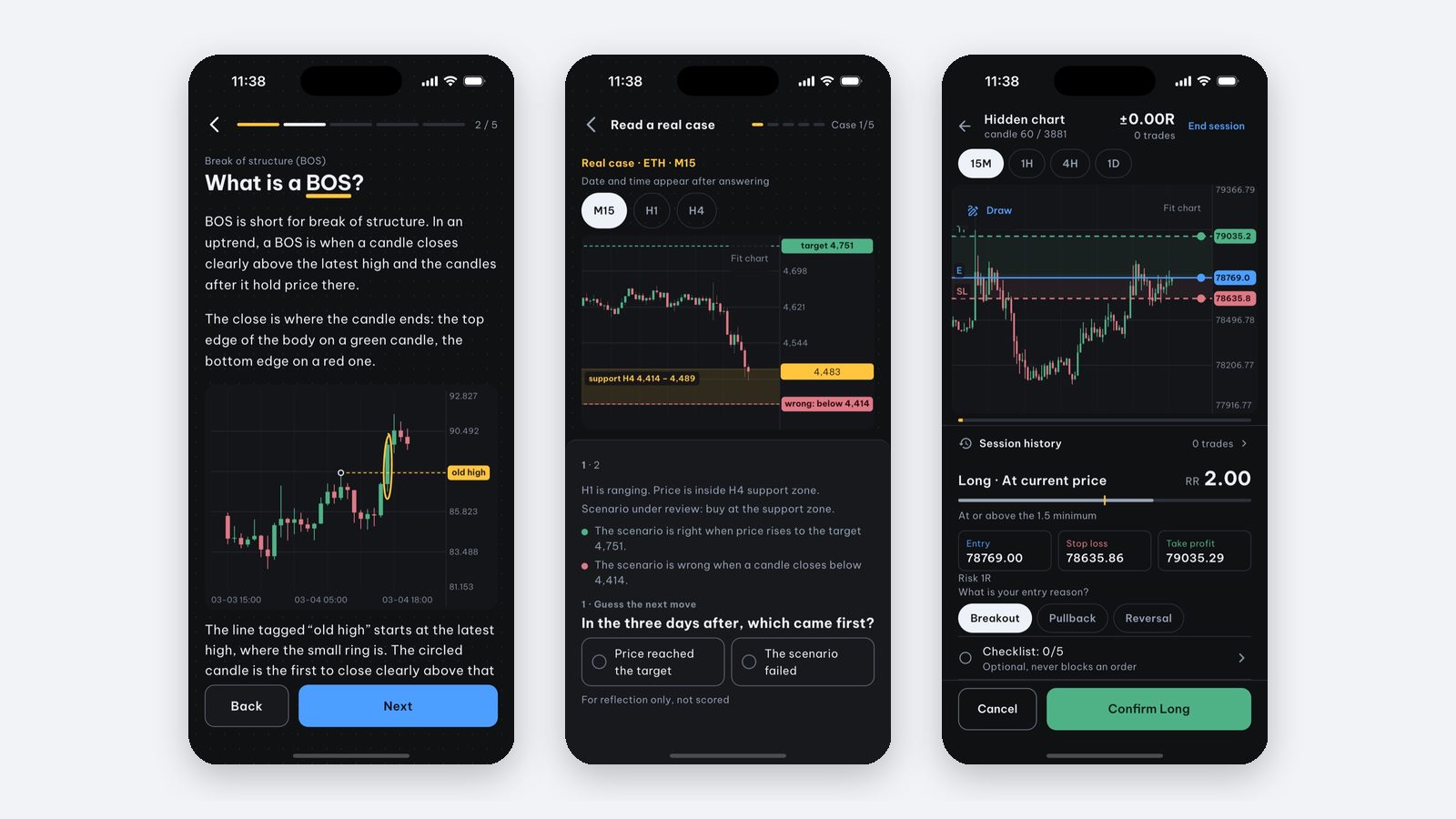
Price Action Trading Simulator is an iPhone and iPad practice app. Real-case exercises stop the chart before a decision, and manual backtesting reveals historical candles one by one. Sessions are saved on the device; there is no broker connection or real-money trading.
The first three candle lessons, opening chart-reading check and one real-case session of five cases are free. The backtest setup is free to browse; starting a session needs Pro. A simulated fee in R is configurable, but real spread, slippage and fills are not reproduced.
Start with a written plan and a journal to identify a specific gap. No completion badge, number of repetitions or checklist on this website certifies readiness to risk money.
Source and scope: this is educational material by the Price Action Trading Simulator development team. Price/account examples are hypothetical unless identified as a historical observation; exact fills and omitted costs are assumptions, not guarantees. Our case-data methodology explains the historical sources, selection and limits.
Frequently asked questions
How long should I practice before trading real money?
There is no universal duration or trade count that establishes readiness. Practice can reveal errors in rules, sizing and execution, but a profitable simulation does not establish that live trading is suitable or profitable.
Are 20 or 30 practice trades enough?
They can be a deliberately chosen first review exercise for logging and rule clarity. They are not a validated threshold for profitability or readiness to risk money.
What does a demo account add after a backtest?
It lets you rehearse the platform and routine as time passes. It still uses simulated money and cannot establish actual fills, costs or your response to financial loss.
Can Price Action Trading Simulator tell me I am ready?
No. It supports lessons, decision exercises and manual backtesting. An exercise score or saved session is not a certification of readiness for real-money trading.
Written by the app’s development team. See the data, selection rules and limits of these first-party examples. Sources & method →
Keep reading
-
Does price action work? How to assess a trading rule
Price action names a broad approach, not a proven edge. Learn how to define one rule, avoid hindsight and test net results on untouched data.
-
Why is my backtest profitable but live trading loses?
Audit the backtest-to-live gap: costs, fills, future leakage, rule changes and market exposure. Use a matched decision record before blaming psychology.
-
Trading journal: what to record and how to review mistakes
Record rules and planned risk before entry, then actual fills, costs and compliance. A journal separates execution mistakes from an untested strategy.