How do I write a trading plan? A fill-in template
A trading plan is a one-page set of written rules you decide before you open a trade: which markets and timeframes, which setup, what triggers your entry, where the stop loss and target go, how much you risk per trade, how much you can lose in a day, and when you review. A good test is that someone else could read it and tell whether any given trade followed it. If a rule can’t be checked that way (“enter when it looks strong”), it isn’t a rule yet.
Why write a trading plan at all?
Writing a plan before the decision creates a reference you can review later. It can reduce the need to invent rules while price moves, although it does not guarantee calm or better returns. When you are tempted to chase a candle or move a stop, the plan has already answered: “no trade” or “the stop stays”.
It also gives you something to measure. Written rules let you distinguish process deviations from compliant trades. Compliance does not establish that the rule has an edge. Your trading journal depends on that split, and so does staying disciplined when a trade goes wrong.
What goes into a trading plan? (fill-in template)
Copy this table and fill the last column. The example column is an illustration, not advice.
| Field | The question it answers | Example | Yours |
|---|---|---|---|
| Markets | What do I trade, and nothing else? | BTC/USDT only | |
| Timeframes | Where do I find the setup, and where do I enter? | H4 for the zone, M15 for the trigger | |
| Setup | What situation do I wait for? | Price returns to a demand zone after a break of structure | |
| Entry trigger | What exact event lets me enter? | An M15 candle closes above the last small high inside the zone | |
| Stop loss | Where is my idea wrong? | Just below the zone’s low | |
| Target | Where do I take profit? | The next swing high, at least 2R away | |
| Planned risk per trade | What is the assumed loss at an exact stop fill? | 10 USD from a fixed 1,000 USD practice balance | |
| Session limit | When do I stop new decisions? | 30 USD net loss; specify treatment of open trades | |
| Review routine | When do I review, and what do I check? | Sunday, 30 minutes: was every trade logged, was every rule followed? |
How to set the stop and size are covered in where to place a stop loss and how to calculate position size.
What does a filled-in plan look like in numbers?
Hypothetical practice model: starting balance 1,000 USD, fixed 10 USD planned risk on each trade and a 30 USD net session-loss limit. Those amounts are 1% and 3% of the fixed starting balance. If risk is recalculated from current equity, the amounts differ. Open positions and worse fills can exceed the session limit.
A trade in that plan: entry at 100, stop loss at 98. The stop distance is 2, so the size is 10 ÷ 2 = 5 units. A target at 106 is 6 away, or 3R, which would pay 30 USD. An assumed fill exactly at the stop costs 10 USD before fees; gaps or slippage can make the realized loss larger.
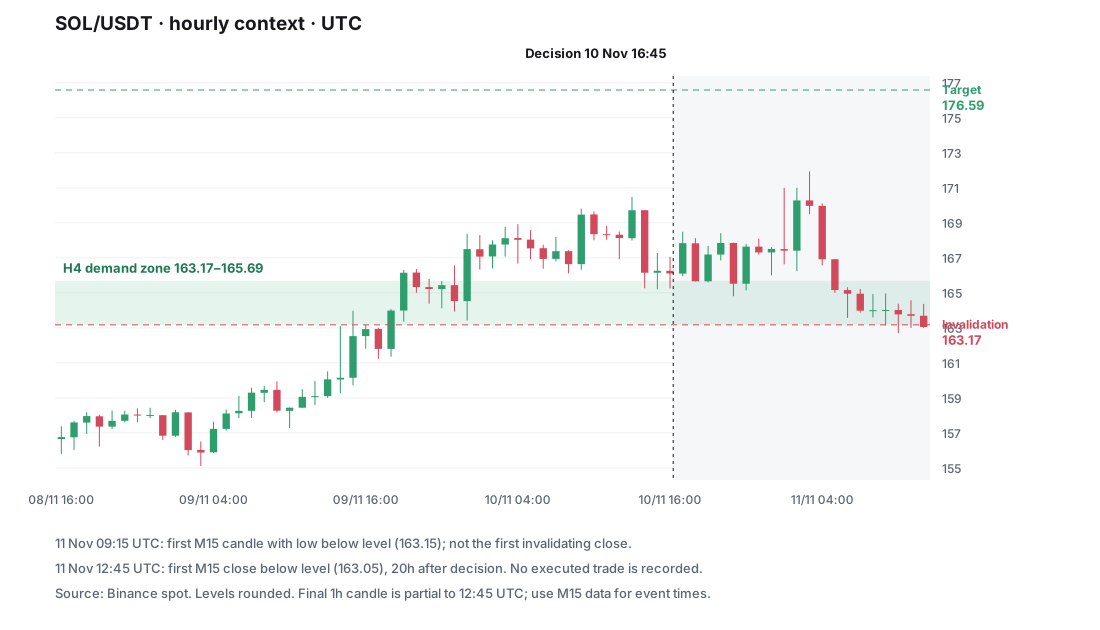
A historical zone event is not a journaled execution. In the SOL/USDT case on November 10, 2025, a later M15 close invalidated the zone at 163.05. A fixed stop at 163.1725 would have been touched in an earlier candle. Only a hypothetical fill exactly at the stop, with no costs, produces −1R by definition. The case methodology records the separate timestamps; it does not establish whether a trader followed a plan.
How specific should each rule be?
Specific enough to answer yes or no.
- Replace adjectives with checks. “Strong move” becomes “a candle closes beyond the level”.
- Write the stop with the entry. No stop on paper, no trade.
- Start with one market and one setup. Add more only after a review.
- Add “if the plan doesn’t say, I don’t trade.” It makes the intended handling of undefined situations explicit.
- Keep it to one page, so you will actually read it.
When should I change the plan?
On review day, never in the middle of a losing streak. Change one rule at a time, write the date, and call the new version v2, so you know which rules produced which results.
Keep the rule version unchanged while collecting a planned sample. You may choose 20 practice trades as an initial review exercise to find missing fields or ambiguous rules. That count is not a statistical threshold for an edge or readiness to risk money. Compare later, unseen periods and costs as described in does price action work?.
How can I practice following a plan without real money?
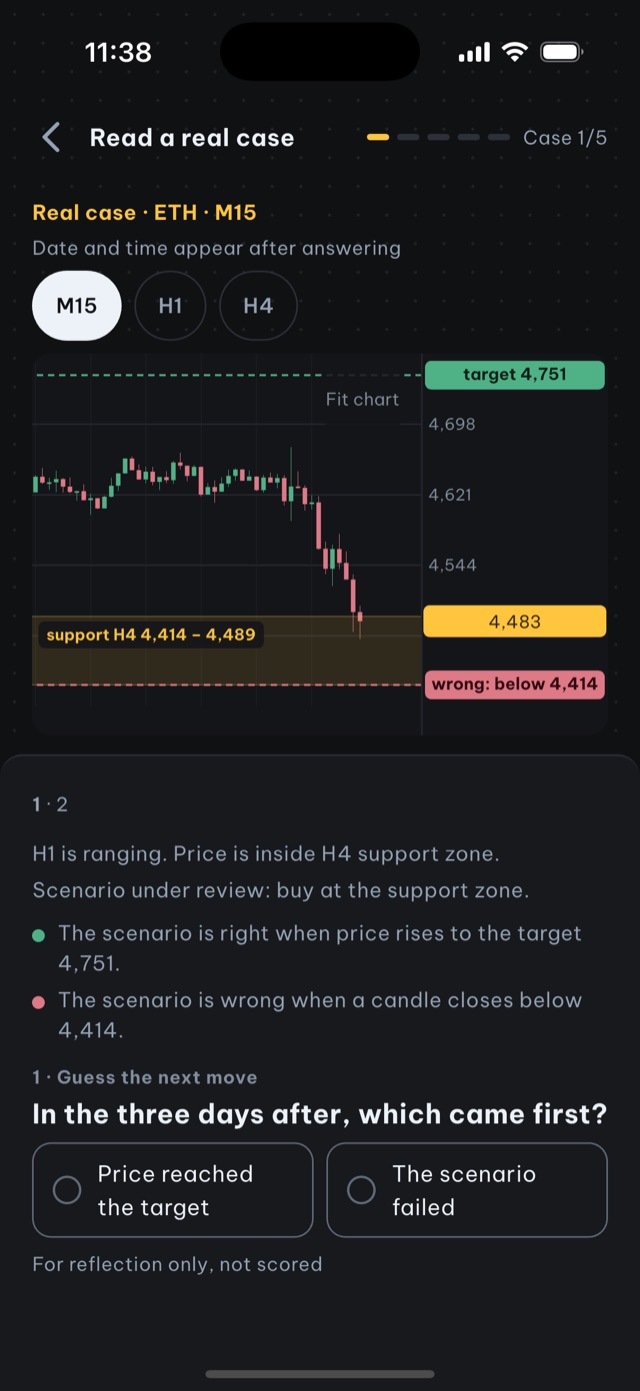
By running the plan on past charts where you can’t see what comes next. Price Action Trading Simulator is an iPhone and iPad app for practicing price action and chart reading on real historical data. It has no real-money trading, no broker connection and no account.
Two features fit a plan well:
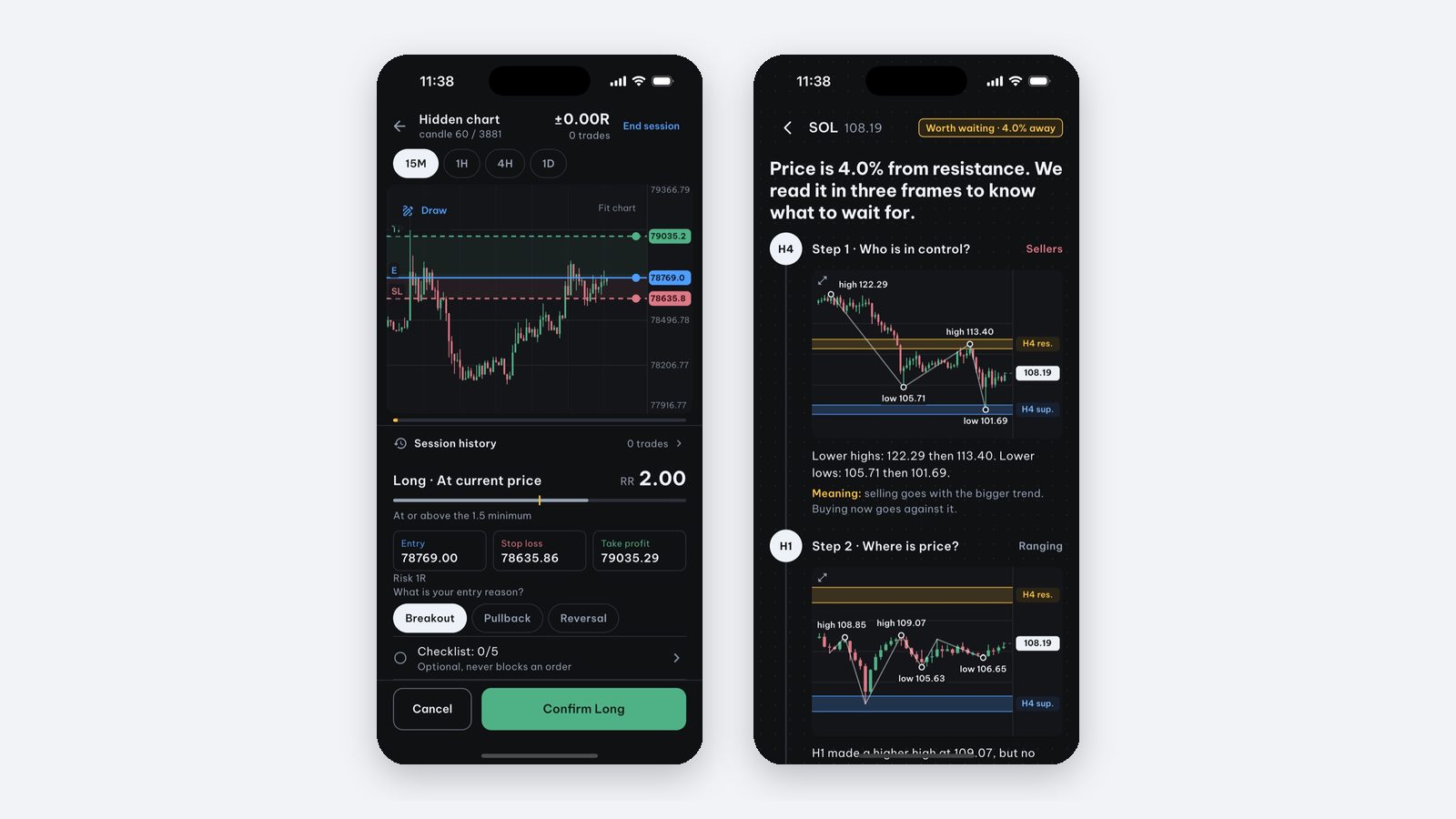
- Real-case practice: 220 real moments of BTC, ETH and SOL over 24 months. The chart stops at the decision point, you choose whether anything is worth waiting for and where the idea is invalidated, then you see what price really did. One real-case session (5 cases) is free.
- Manual backtest: reveal candles one by one, place entry, stop and take profit on the chart, with a random start and hidden dates, and a simulated fee per trade in R. Starting a session needs Pro.
Fill the template and choose a fixed practice review session to check whether its rules are unambiguous. This is a process exercise, not proof of profitability. The method is in manual backtesting on iPhone.
Source and scope: this is educational material by the Price Action Trading Simulator development team. Price/account examples are hypothetical unless identified as a historical observation; exact fills and omitted costs are assumptions, not guarantees. Our case-data methodology explains the historical sources, selection and limits.
Frequently asked questions
What should a trading plan include?
At minimum: the markets and timeframes you trade, one setup, the exact entry trigger, where the stop loss and target go, risk per trade, a maximum loss per day, and when you review your trades. Every rule should be checkable, so you can tell afterward whether a trade followed it.
How long should a trading plan be?
One page is enough. If you cannot read it in two minutes before a trade, it is too long to be used. Start with one market, one setup and one risk number, and add rules only when a review shows you need them.
How much should I risk per trade in my plan?
There is no universal number. A percentage such as 1% can illustrate a chosen practice budget, not a universal beginner ceiling or guarantee. State the equity base, cost and fill assumptions, then calculate planned exposure; actual losses can exceed it.
How do I practice a trading plan without real money?
Run it on historical charts where the future is hidden: reveal candles one at a time, place entry, stop and target before each reveal, and log the result in R. Price Action Trading Simulator offers this on iPhone and iPad with no real-money trading.
Written by the app’s development team. See the data, selection rules and limits of these first-party examples. Sources & method →
Keep reading
-
Trading journal: what to record and how to review mistakes
Record rules and planned risk before entry, then actual fills, costs and compliance. A journal separates execution mistakes from an untested strategy.
-
How much should a beginner risk per trade? Risk management basics
Learn planned risk, R and drawdown with hypothetical examples. A 1% rule is a chosen budget, not a safety threshold or guaranteed stop-loss limit.
-
Know candlestick patterns but not when to enter? How to practice
You spot candlestick patterns on finished charts but freeze on a live one? How to practice trade entries on real cases, with a worked example and data.