How much should a beginner risk per trade? Risk management basics
Choose a risk budget explicitly and understand the assumptions behind it. There is no universal beginner percentage that makes trading safe or suitable. The often-discussed “1% rule” is a way to express planned loss at a stop; it does not guarantee that an actual loss stays at 1% or that the strategy has an edge.
What does a 1% example mean?
In a hypothetical 1,000 USD account, 1% is 10 USD. Call that initial planned cash risk 1R. It is different from the position’s value: a position may be much larger than 10 USD, while a chosen price move to a stop represents 10 USD under an exact-fill model.
Choose the exit rule before calculating units. A fixed stop, a close-based exit and a stop-limit order do not have the same execution. Gaps, slippage, fees, currency changes and liquidation can make the loss exceed the planned amount. See stop rules and position sizing.
How does a losing sequence affect equity?
This table assumes ten consecutive full losses, each a fixed percentage of the current balance, with exact fills and no costs. It is arithmetic, not a forecast or a recommended risk range.
| Fraction of current balance | Calculation after ten losses | Remaining balance |
|---|---|---|
| 1% | 1,000 × 0.99¹⁰ | About 904 USD |
| 2% | 1,000 × 0.98¹⁰ | About 817 USD |
| 5% | 1,000 × 0.95¹⁰ | About 599 USD |
| 10% | 1,000 × 0.90¹⁰ | About 349 USD |
If instead you lose a fixed 10 USD each time, ten losses leave 900 USD before costs. Do not mix these two models. The table establishes no probability of such a sequence; our selected zone-case counts cannot supply that probability either.
Why does drawdown matter?
From 1,000 USD, a 50% loss leaves 500 USD. Recovering to 1,000 then requires 500 ÷ 500 = 100%, before costs. A 20% loss leaves 800 USD and needs 200 ÷ 800 = 25%. Reducing planned exposure changes this arithmetic, but cannot turn a losing rule into a profitable one.
What does a session loss limit specify?
A complete limit names its base, period, treatment of costs and open positions. For example, a practice rule could use fixed 10 USD risk and stop new decisions after 30 USD of net realised losses. That is 3R and 3% of a fixed 1,000 USD starting balance. Existing positions can still add losses, and orders may execute beyond planned levels.
If risk is recalculated as 1% of remaining equity, the first three exact full losses are 10, 9.90 and 9.801 USD, totalling 29.701 USD, not 30. Multiple positions may also lose on the same move; adding their planned stop amounts does not guarantee a portfolio loss bound.
A useful practice check
Write the equity base, cash risk, stop rule, units and cost assumption before each simulated decision. At review, compare planned and assumed filled losses rather than checking only whether the chart touched a level. These are process exercises, not live-readiness tests.
Price Action Trading Simulator provides historical manual backtesting with a configurable simulated fee in R and saved sessions. Setup is free to inspect; starting a session needs Pro. One real-case session of five cases is free. The app has no real-money trading or broker connection and does not reproduce live execution. To evaluate the economics of a rule, read win rate, reward and costs.
Source and scope: this is educational material by the Price Action Trading Simulator development team. Price/account examples are hypothetical unless identified as a historical observation; exact fills and omitted costs are assumptions, not guarantees. Our case-data methodology explains the historical sources, selection and limits.
Frequently asked questions
How much should a beginner risk per trade?
There is no percentage that establishes suitability or safety. You can compare hypothetical budgets such as 0.5% and 1%, but those examples are not a personal recommendation. A stop amount is planned risk, not a guaranteed loss limit.
What is R in trading?
1R is the initial cash risk chosen for a trade. If it is 10 USD, a hypothetical exact stop fill losing 10 USD is −1R before costs. Actual fills and costs can produce a loss larger than 1R.
Does a daily limit of 3R equal 3%?
Only under the matching base assumption. With fixed risk of 10 USD from a 1,000 USD starting balance, 3R is 30 USD or 3% of that starting balance. Recalculating risk from changing equity makes the dollar amounts differ.
Does risk management make a strategy profitable?
No. It describes and constrains planned exposure under assumptions. It does not create a positive expected return or prevent losses, gaps or liquidation.
Written by the app’s development team. See the data, selection rules and limits of these first-party examples. Sources & method →
Keep reading
-
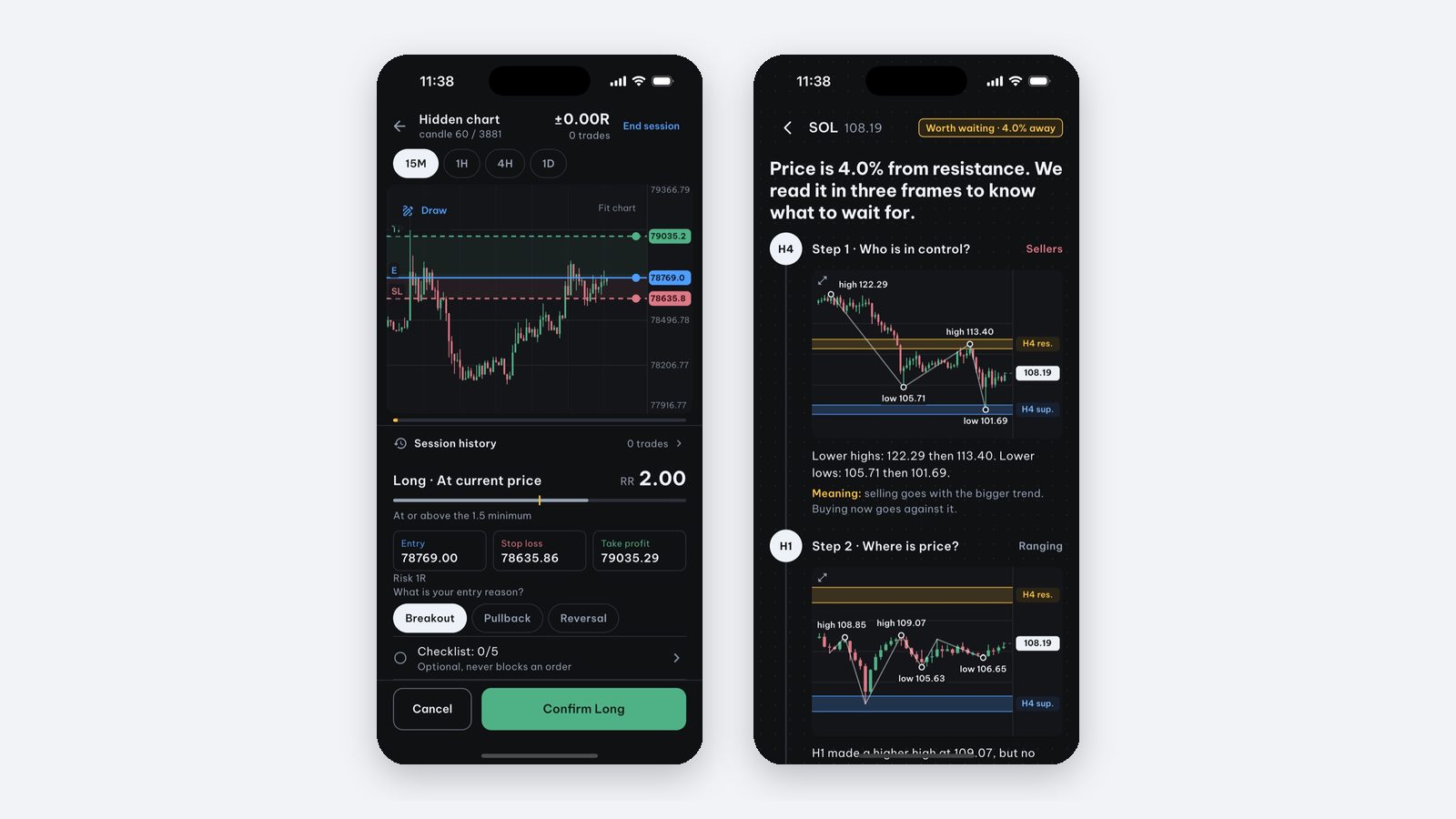
How do I calculate position size from my stop loss? Worked examples
Size a linear position from a chosen risk budget, stop distance and unit value. Examples state fill, cost, contract and currency assumptions explicitly.
-
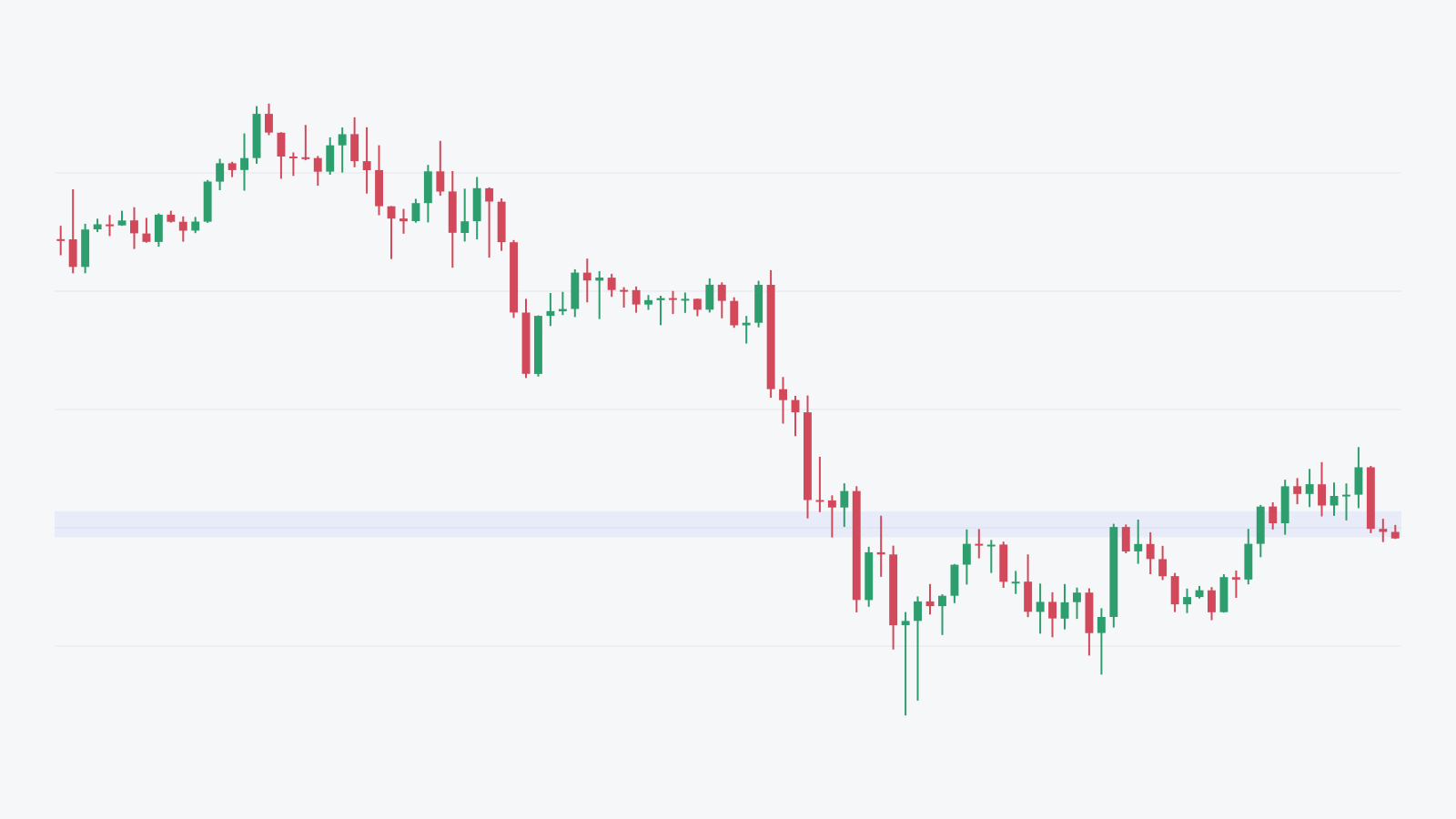
Where should I place my stop loss? A price action guide
Choose an exit rule before sizing a trade. A fixed stop and a candle-close invalidation are different; a real SOL timeline shows why fills matter.
-
Can a 40% win rate at 2R make money after trading costs?
At 40% wins and 2R payoff, gross expectancy is 0.2R per trade. Calculate how fees, spread, slippage and variable exits change break-even.