Where should I place my stop loss? A price action guide
Choose the exit rule before calculating position size. A price action level can define where your idea is rejected, but a candle-close invalidation is different from a resting stop order. Write both the condition and the execution assumption; otherwise “risking 1R” has no precise meaning.
Fixed stop or candle-close exit?
| Rule | What the rule observes | What to account for |
|---|---|---|
| Fixed stop order | The venue’s specified trigger during price movement | Trigger source, gaps, slippage and actual fill |
| Close-based exit | A completed candle beyond a level on a chosen timeframe | Delay until close, monitoring and later execution price |
| Stop-limit order | Stop trigger followed by a limit order | Price constraint can leave the position unclosed |
The SEC’s stock-order bulletin explains that a stop trigger is not a guaranteed fill price and that stop-limit orders may not execute. Check the rules for your own instrument and venue; the stock bulletin does not define crypto triggers.
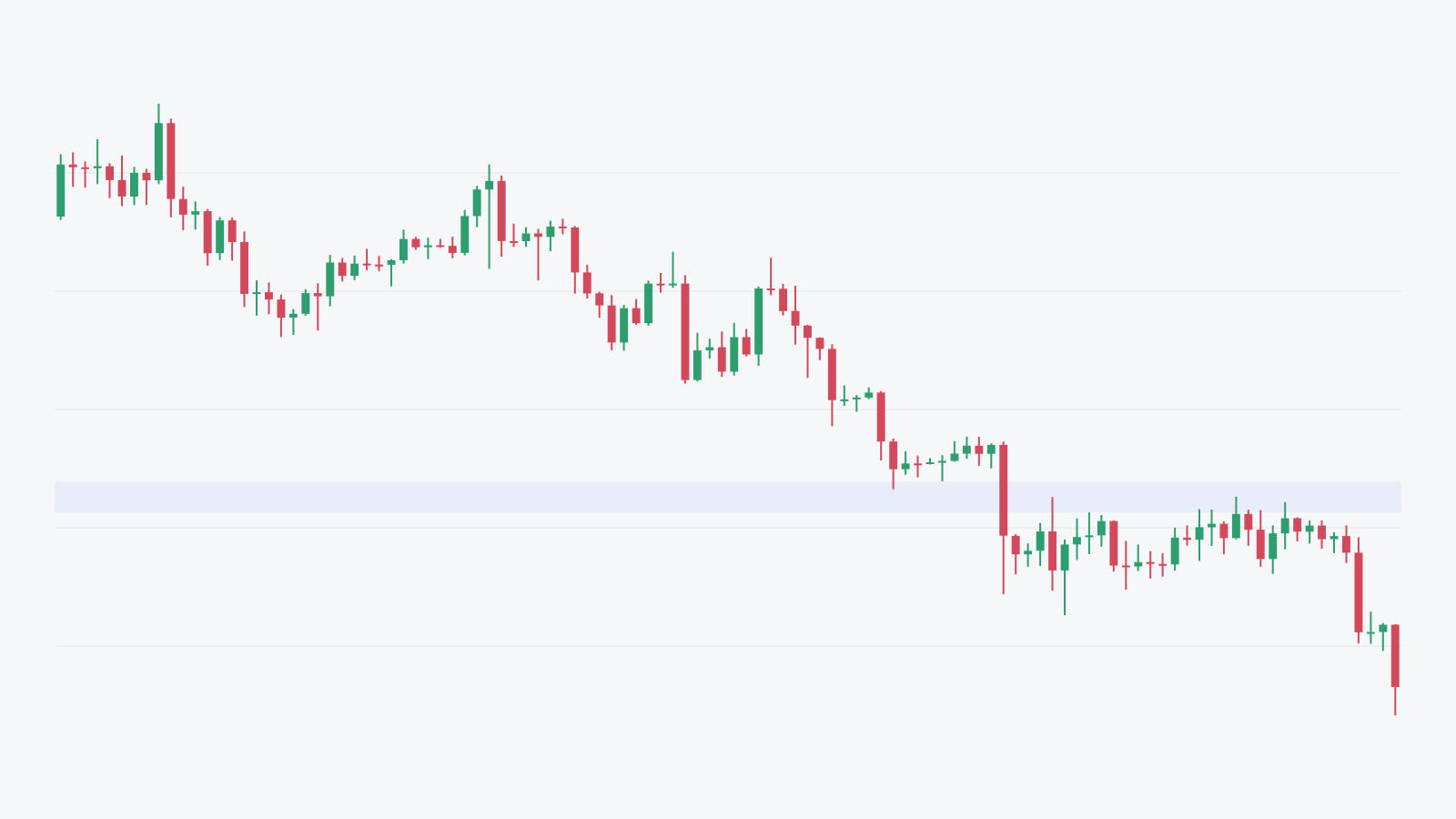
A real SOL timeline: touch happened before close
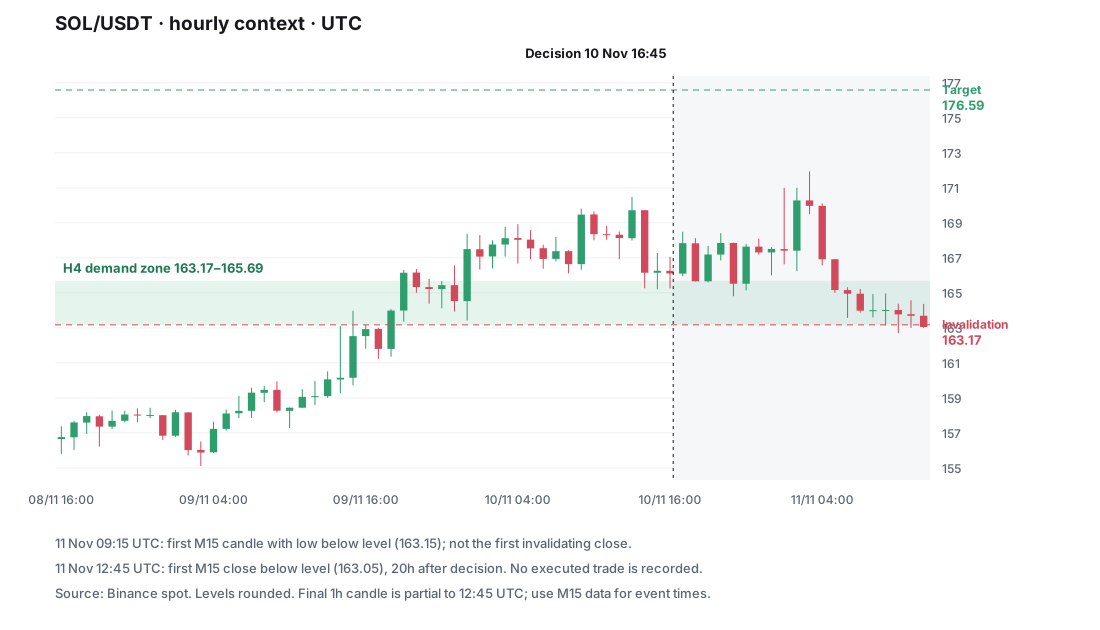
Our stored SOL/USDT case starts on November 10, 2025 at 16:45 UTC. Its H4 demand zone is 163.1725–165.6875; the invalidation reference is 163.1725 and target is 176.5875.
| Observation | UTC time on November 11 | Price |
|---|---|---|
| First subsequent M15 candle low below invalidation | Candle opens 09:15 | Low 163.15 |
| First subsequent M15 close below invalidation | Candle opens 12:30, closes 12:45 | Close 163.05 |
The second event creates the stored invalidatedFirst label, 20 hours after the decision. Neither event records a broker fill. The methodology and raw case explain these timestamps and the dataset limits.
What does the risk arithmetic look like?
Hypothetical execution using rounded reference levels: assume entry 165.69, fixed stop fill 163.17 and a 10 USDT risk budget. Ignore costs and assume a linear SOL/USDT position.
- Stop distance = 165.69 − 163.17 = 2.52 USDT per SOL.
- Size = 10 ÷ 2.52 ≈ 3.968 SOL before rounding.
- Fill exactly at that stop: loss = 10 USDT = 1R before costs.
- Exit instead at 163.05: loss ≈ 3.968 × 2.64 = 10.48 USDT, about 1.048R before costs.
These are two different simulated rules, not returns observed in the case bank. Actual costs or worse fills increase the loss further.
How do I choose a level without hindsight?
Write the setup, reference level, trigger type and any buffer before revealing the future. A rule such as “exit after an M15 close below the zone” is checkable; “give it more room if it looks promising” is not. Test candidate buffers rather than treating an arbitrary ATR fraction as correct. If the required size is below the minimum allowed, record a skip instead of changing the stop just to fit.
Use position sizing for the calculation and a journal for assumed versus actual fills.
Price Action Trading Simulator lets you place entry, stop and target on historical charts without real money or a broker connection. Backtest setup is free to view; starting a session needs Pro. Its configurable fee in R is a simplification, not a reproduction of live execution.
Source and scope: this is educational material by the Price Action Trading Simulator development team. Price/account examples are hypothetical unless identified as a historical observation; exact fills and omitted costs are assumptions, not guarantees. Our case-data methodology explains the historical sources, selection and limits.
Frequently asked questions
Where should I place a stop loss with price action?
Start with the rule that rejects your trade idea, then specify the order trigger and size from the stop distance. A zone boundary is a reference, not a universally correct stop. Test any buffer as part of the rule.
Is a candle-close invalidation the same as a stop order?
No. A close-based rule waits for a specified candle to finish. A stop order may trigger during that candle under the venue’s rules. They can exit at different times and prices.
Does a stop loss guarantee a loss of exactly 1R?
No. Exactly −1R assumes the planned entry and stop fill with no added costs. Execution prices can differ; a stop-limit order can fail to fill.
How do I size a hypothetical position from its stop?
Before costs, divide the cash risk budget by the price distance times the instrument’s money value per unit. Check contract size, currency conversion and minimum trade size.
Written by the app’s development team. See the data, selection rules and limits of these first-party examples. Sources & method →
Keep reading
-
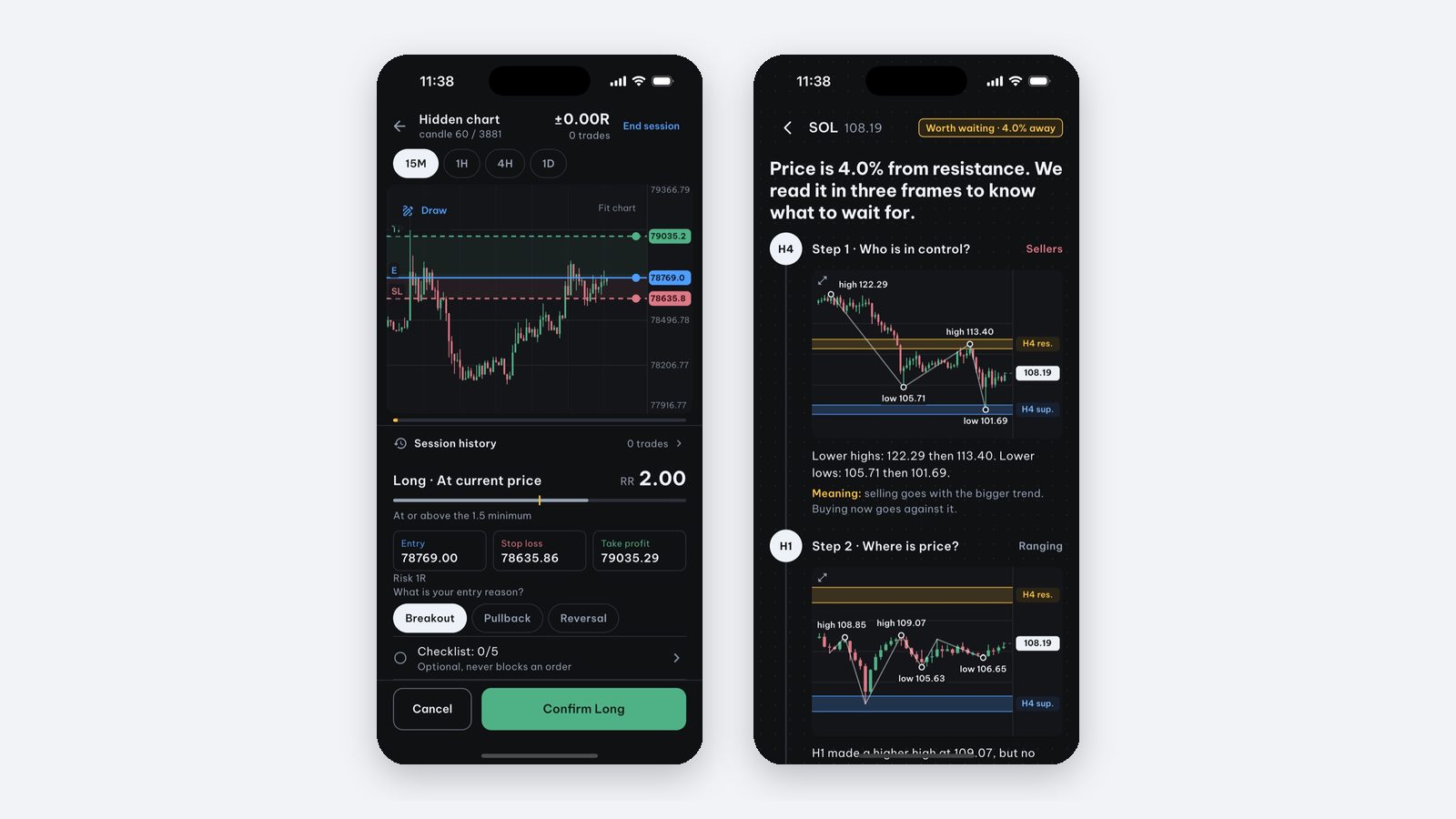
How do I calculate position size from my stop loss? Worked examples
Size a linear position from a chosen risk budget, stop distance and unit value. Examples state fill, cost, contract and currency assumptions explicitly.
-
Where do our real trading cases and zone statistics come from?
How our selected Binance cases, fixed draw and 72-hour labels work. Inspect the SOL timeline, public files and limits of the 110-touch aggregate.
-
What Is Risk-Reward Ratio? The Win Rate You Need to Break Even
R:R compares planned risk and reward. With fixed +2R wins and −1R losses, break-even is 33.3% before costs. Examples show why targets are not realised payoffs.