What is FOMO in trading and how do I stop chasing big candles?
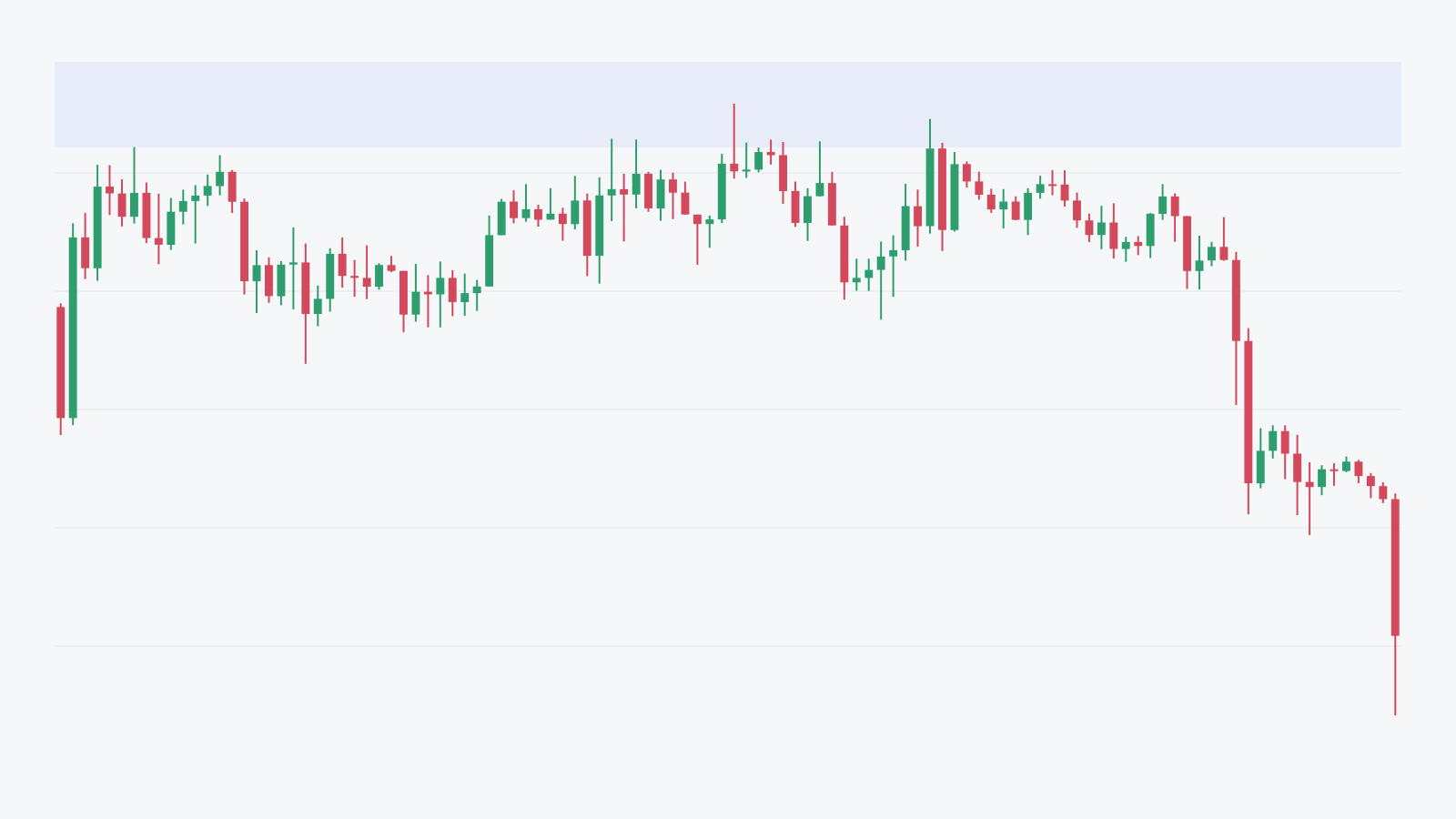
FOMO in trading means entering a trade because you are afraid of missing a move, usually by chasing a big candle that has already run, not because your plan told you to. One practice rule is to enter only at a price you chose in advance (a zone, a confirmation condition and an invalidation). If price has left that zone and the risk-reward recalculated at the current price is below your minimum, skip it: standing aside is a decision.
What does FOMO look like while you trade?
Use these possible actions as prompts for your journal; they do not diagnose your emotions:
- You see a long green (or red) candle and think “I have to get in now or it’s gone.”
- You enter without knowing where you are wrong, or you place the stop loss arbitrarily far or close just to make the trade “fit.”
- You enter at a much worse price than the entry you had planned.
- You increase position size to “make up” for the part you missed.
- You enter before the candle closes and look for a reason afterward.
How can chasing change risk-reward?
If the stop and target stay fixed while a long entry rises toward the target, the risk distance grows and the remaining reward shrinks. This describes that geometry, not the success rate of all momentum entries. Risk-reward (RR) compares what you are willing to lose with what you hope to gain; see risk-reward ratio explained.
Hypothetical example: account 1,000 USD, chosen fixed risk 10 USD (1% of the starting balance), exact fills and no costs. A hypothetical asset is priced in USD around 100. Your plan: buy at 100, stop loss 98, target 106. Then a big candle pushes price to 104 and you chase, keeping the stop at 98 and the target at 106.
| Planned entry | Chasing at 104 | |
|---|---|---|
| Entry | 100 | 104 |
| Stop loss | 98 | 98 |
| Target | 106 | 106 |
| Risk per unit | 2 | 6 |
| Reward per unit if target hits | 6 | 2 |
| RR | 1:3 | about 1:0.33 |
| Size for 10 USD planned loss at an exact stop fill | 5 units | about 1.67 units |
| Gain if target hits | 30 USD | about 3.33 USD |
Under the same hypothetical fills, buying 5 units out of habit changes the exposure: at 104 with a stop at 98 you could lose 30 USD (3% of the account) for a maximum gain of 10 USD. Moving the stop solely to recover the old ratio creates a different rule, which needs its own test.
What does real data say about entering at zones?
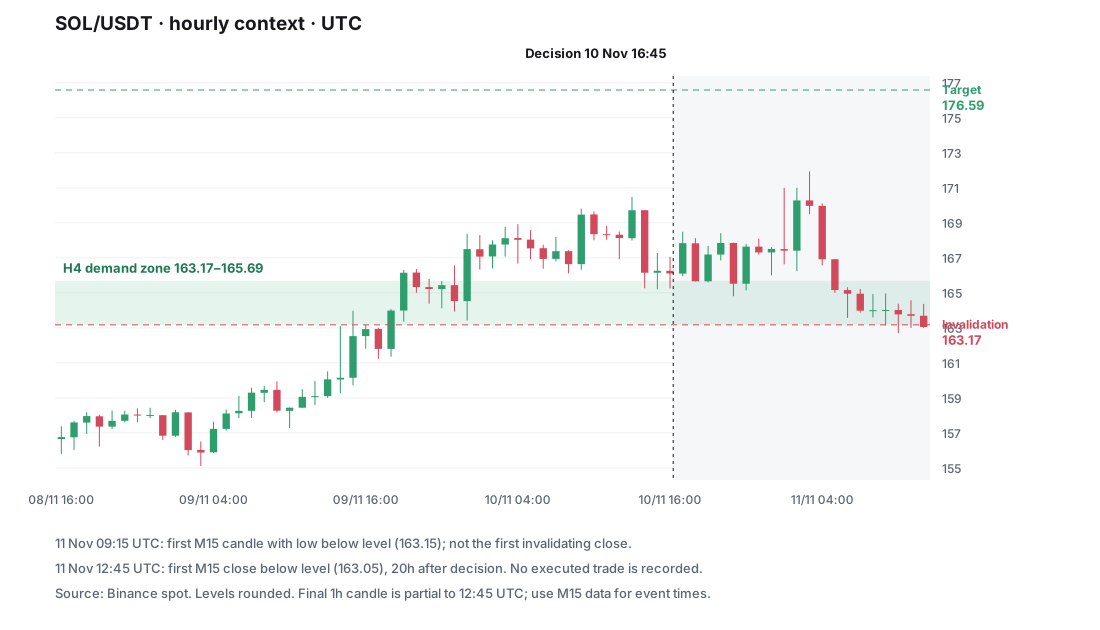
Our developer-maintained case bank contains 110 selected BTC, ETH and SOL zone-touch cases dated October 2024–October 2026. In its stored 72-hour observation window, 25 are labelled targetFirst, 74 invalidatedFirst and 11 unresolved. These are zone events, not executed trades or a strategy win rate. They do not test whether waiting for confirmation, chasing a move or a different stop improves returns. See the case-data methodology for selection, event rules and limits.
For the hypothetical entry comparison above, holding stop and target fixed makes the later entry offer less reward for each unit of risk. That arithmetic alone does not tell us the probability of either trade succeeding.
How do I stop FOMO? 5 practical steps
- Write the plan before the candle runs: which zone, what the entry condition is (for example, a 15-minute candle closing above X), the invalidation and the target. How to write a trading plan walks through it.
- Set a “missed it” threshold: for example, if RR recalculated at the current price is below 1:2, or price has moved past your entry by a distance you set in advance, the trade is void. Put this in the plan from the start.
- Decide on closed candles. A candle that is still moving can change shape completely before it closes.
- Wait for price to return to the zone, or for the next setup. There will be other setups; what you cannot get back is capital lost on a rushed trade.
- Log the trades you skipped, with the reason (“RR down to 0.33”), then look at what price actually did. Review whether the skip matched the rule; the later outcome does not validate it by itself.
If the urge stays strong, see trading psychology: how to stay disciplined for habits that help.
Is standing aside the same as missing out?
No. Standing aside is a decision with its own result: you avoided a trade with poor RR. In your account, a trade you did not take costs nothing, while a rushed one can cost 3%, as in the example above.
Treat “skip” as an equal option next to “enter” and “wait,” and write it in your journal like any other decision.
Practice waiting for the right entry without real money
A simulation cannot establish that a fear response will transfer to live trading. Practicing on historical charts lets you repeat the “enter, wait or stand aside” decision many times without risking anything.
Price Action Trading Simulator is an iPhone and iPad app for practicing price action on real historical data. Two parts matter most here:
- Real cases: 220 real BTC, ETH and SOL moments over 24 months. The chart stops at the decision point, you choose whether anything is worth waiting for and where the idea is invalidated, then watch what price really did. The first session (5 cases) is free.
- Manual backtest (Pro): reveal candles one by one, place entry, stop loss and take profit on the chart, with a random start and hidden dates.
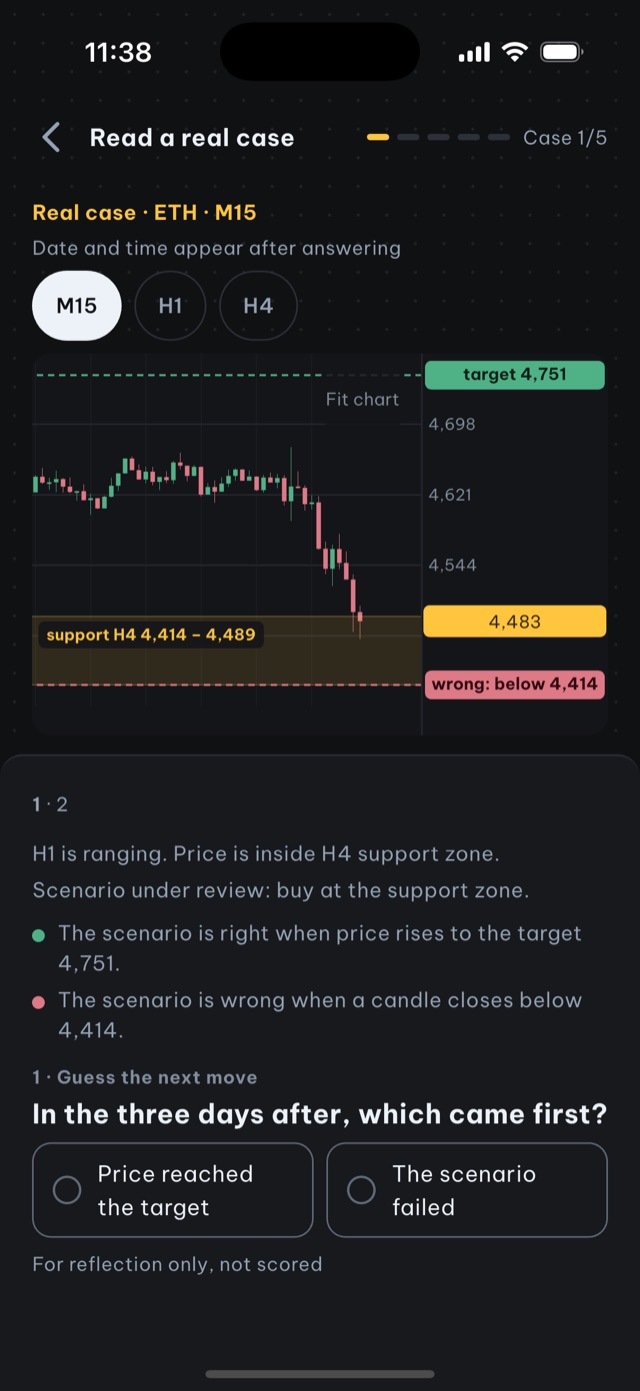
The app trades no real money, has no broker connection, needs no account and keeps progress on your device.
Source and scope: this is educational material by the Price Action Trading Simulator development team. Price/account examples are hypothetical unless identified as a historical observation; exact fills and omitted costs are assumptions, not guarantees. Our case-data methodology explains the historical sources, selection and limits.
Frequently asked questions
What is FOMO in trading?
FOMO (fear of missing out) is entering a trade because you are afraid of missing a move, usually after price has already run a big candle, rather than because your plan has an entry rule for it.
How do I stop FOMO when price is moving fast?
Write your entry, invalidation and target in advance. If price has left your entry and the risk-reward recalculated at the current price is below the minimum in your plan, skip the trade, note that you skipped it and wait for the next setup.
Should I buy after price has already moved away from my entry?
Recheck the written rule instead of treating every move as a new entry. In a hypothetical example, entry 100, stop 98 and target 106 gives 1:3; entry 104 with the same levels gives about 1:0.33 before costs. That comparison does not measure either entry’s success rate.
Is there an app to practice waiting for the right entry without real money?
Price Action Trading Simulator has real-case practice: the chart stops at the decision point, you choose whether anything is worth waiting for, then watch what price really did. It trades no real money, and the first real-case session (5 cases) is free.
Written by the app’s development team. See the data, selection rules and limits of these first-party examples. Sources & method →
Keep reading
-
Know candlestick patterns but not when to enter? How to practice
You spot candlestick patterns on finished charts but freeze on a live one? How to practice trade entries on real cases, with a worked example and data.
-
How do I know if I'm overtrading, and how do I stop?
Compare your trade count with written rules, calculate assumed costs and log unplanned entries. A daily cap is a practice choice, not a universal cure.
-
How do I write a trading plan? A fill-in template
A trading plan is one page of rules written before you trade: market, setup, entry, stop, target, risk per trade, daily loss limit and a review routine.